
Union County Court Records After a Jail Arrest
A Union County arrest begins as a custody event, but it turns into a court record only when a prosecutor acts. The booking charge is the arresting agency's view at intake. It can change, shrink, grow, or disappear once the Office of the State Attorney for the Eighth Judicial Circuit reviews the case and decides what to file. The charges the prosecutor files are what open the case and become the official court record.
Keep the two sides separate. The custody and booking side is covered on the jail inmate records page, and booking photos are on the jail roster mugshots page. The court record itself is the charge the prosecutor filed and everything that follows it, tracked through the clerk's case index rather than the jail.
How to Find Union County Court Records After an Arrest
Union County court records run through the Clerk of Court and the Civitek Online Court Records Search, branded for Union County. The portal opens with four access options, and only the Public option allows anonymous searching. The access screen is shown below.
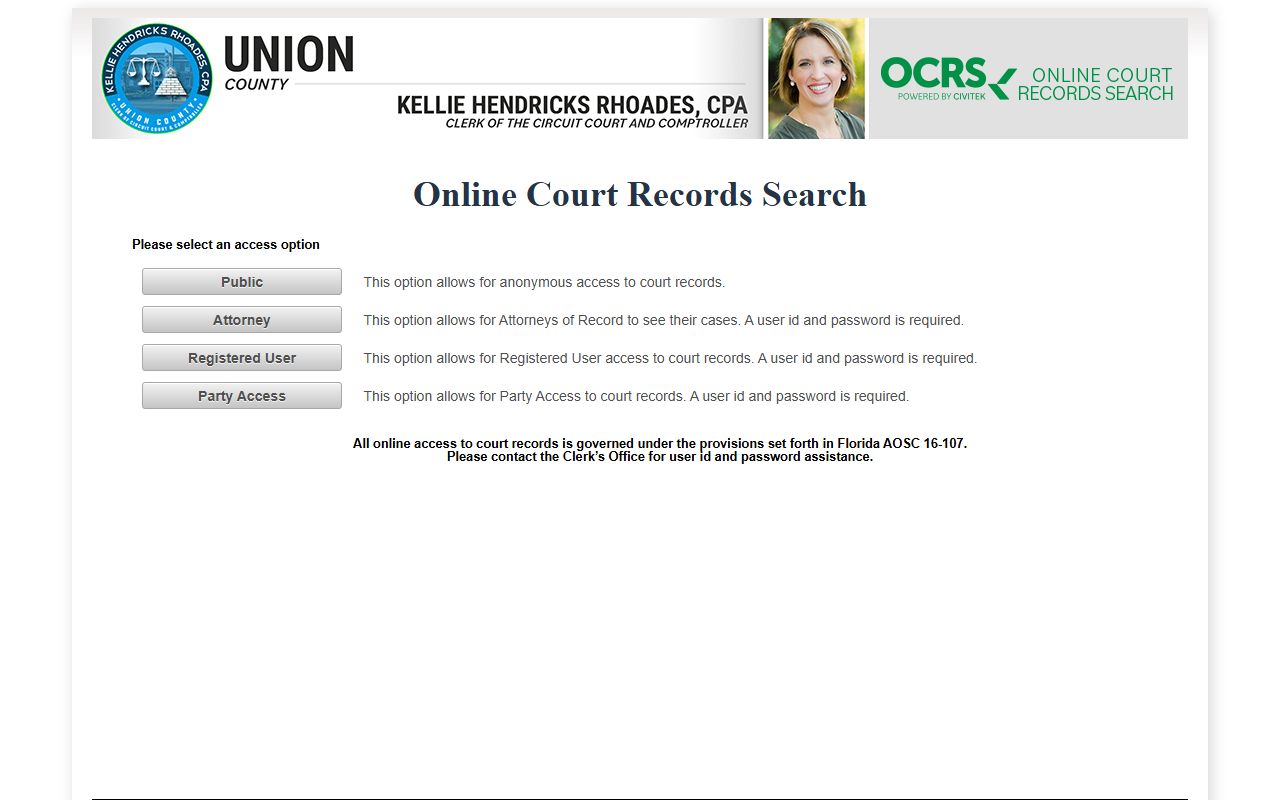
From the Union County court records search, the steps are simple, though restricted cases may need help from the clerk.
- Open the Union County OCRS portal and choose Public for anonymous access.
- Search by the defendant's name or by case number.
- Open the case and read the charge list the prosecutor filed.
- Check each charge's level and current status, and note that booking charges can differ from filed charges.
For statewide criminal-history records rather than a single case, the Florida Department of Law Enforcement runs a criminal-history request process. The Union County Clerk handles official court-record routing for older or restricted files.
How Charges Get Filed After an Arrest
Walking forward from the arrest, booking happens first at the jail. The court record begins when a charging document is filed. Florida cases generally start one of three ways, and the type signals how serious the charge is.
| Complaint | Information | Indictment | |
|---|---|---|---|
| Filed By | Officer / Prosecutor | State Attorney | Grand Jury |
| Common For | Misdemeanors | Many felonies | The most serious felonies |
| Starts | The case | The case | The case |
The State Attorney for the Eighth Judicial Circuit, Brian S. Kramer, prosecutes Union County along with Alachua, Baker, Bradford, Gilchrist, and Levy Counties. His office reviews law-enforcement submissions and files or declines the formal charges that become the court record.
Charge Status in Court Records After an Arrest
Charges move as a case develops. A prosecutor may amend, reduce, add, or drop a charge, and a judge may dismiss one. The booking charge on the night of the arrest is often not the charge the court record ends with. The terms below show up on the Union County case index.
| Status | What It Means |
|---|---|
| Pending | The charge or case is still open and moving through court. |
| Amended / Reduced | The prosecutor changed the charge or lowered it to a less serious offense. |
| Dismissed | The court or prosecutor ended the charge without a conviction. |
| Nolle Prosequi | The prosecutor declined or dropped the prosecution. |
Bond and Release After an Arrest
Bond is usually set or reviewed by a judicial officer early in the case, sometimes at a first appearance. Union County does not publish an online bond-payment portal or a fee schedule, so the verified channels are the jail phone line at (386) 496-2501 for current custody and the clerk or court record for the bond order. A person can have a bond on one charge and still stay in jail because of a hold.
| Bond Type | How It Works |
|---|---|
| Cash Bond | The full amount is paid through the authorized local channel. |
| Surety Bond | A licensed bail bond agent posts the bond for a fee or collateral. |
| PR / Own Recognizance | The court releases the person on conditions without full cash. |
| No-Bond Hold | Release is blocked until the court acts or another hold clears. |
A hold can come from another county, a warrant, the Department of Corrections, probation, federal authorities, or an immigration detainer. Always ask the jail whether any hold exists.
Warrants That Lead to an Arrest
An outstanding warrant is a common reason a person ends up booked into the Union County Jail. The sheriff's Civil and Warrants page handles service of process, not a public warrant search, and the office reports serving more than 1,500 warrants, writs, summonses, injunctions, and court orders a year. There is no online active-warrant list to browse.
To check for a possible warrant, the practical paths are the Union County OCRS case search, the Clerk's Office for bench warrants that may not appear on a sheriff site, and a records request. The sheriff's office does not give legal advice, so anyone trying to clear a warrant should work through the court, the clerk, or an attorney rather than a website.
Charges vs. Convictions in an Arrest Record
Being arrested and charged is not the same as being convicted. A charge is an accusation; a conviction is a verdict or a plea. Court records show both stages, and reading the disposition is what tells you which one applies.
| Charge | Conviction | |
|---|---|---|
| Stage | Accusation | Verdict or plea |
| Burden of Proof | Probable cause | Beyond a reasonable doubt |
| Public Record | Yes | Yes |
Sealed vs. Expunged Records After an Arrest
Florida lets some people seal or expunge an eligible record after a dismissal or a qualifying outcome. The State Attorney cannot walk an applicant through it beyond a defined role and points people to the Florida Department of Law Enforcement, which runs the Certificate of Eligibility process under Florida Statutes § 943.0585. Eligibility is specific, so nothing here is a promise that a given record qualifies.
| Sealed | Expunged | |
|---|---|---|
| Visibility | Hidden from public view | Destroyed or treated as if it never existed |
| Law Enforcement | Limited access | Very limited access |
| Eligibility | Set by Florida statute and prior record | Often tied to a dismissal or no-conviction outcome |
The FDLE seal and expunge pages explain the steps. Removing a booking photo follows the same record-clearing route, covered on the jail roster mugshots page.
Prosecutor and Public Records Requests
The Eighth Judicial Circuit State Attorney keeps a public-records process under Florida law. Its local Union County office is at 103 N. Lake Ave, Lake Butler, with the central records custodian in Gainesville. The office's records policy page is shown below.
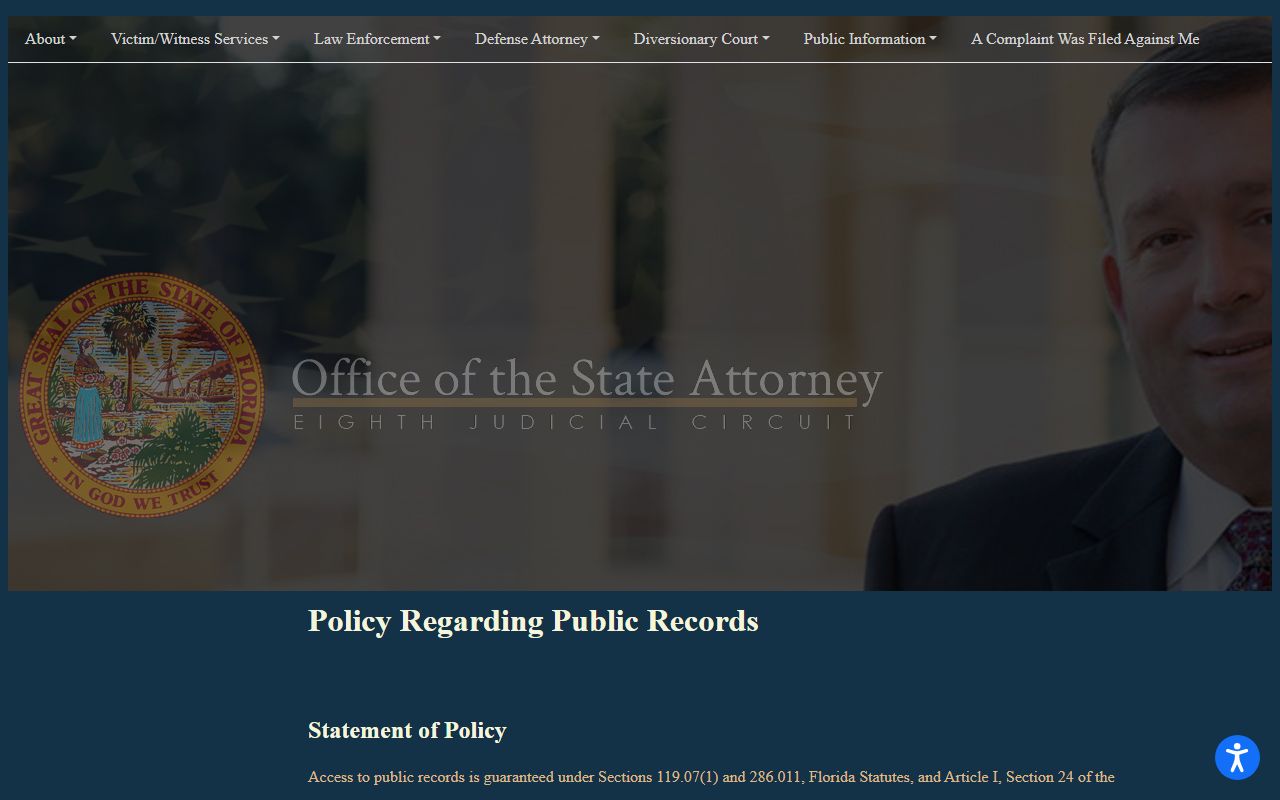
Requests for prosecutor records go to the custodian listed on the State Attorney records page, and the office may charge for the cost of compiling a response.
Important: This is a private reference site and not a consumer reporting agency, so nothing here may be used for employment, housing, credit, or other FCRA-covered screening.
Who Files Charges After a Union County Arrest
Charges in Union County are filed by the Office of the State Attorney for the Eighth Judicial Circuit. State Attorney Brian S. Kramer took office in 2021 and prosecutes six counties, Alachua, Baker, Bradford, Gilchrist, Levy, and Union, with an office that handles roughly 20,000 criminal cases a year. His official biography page is shown below.
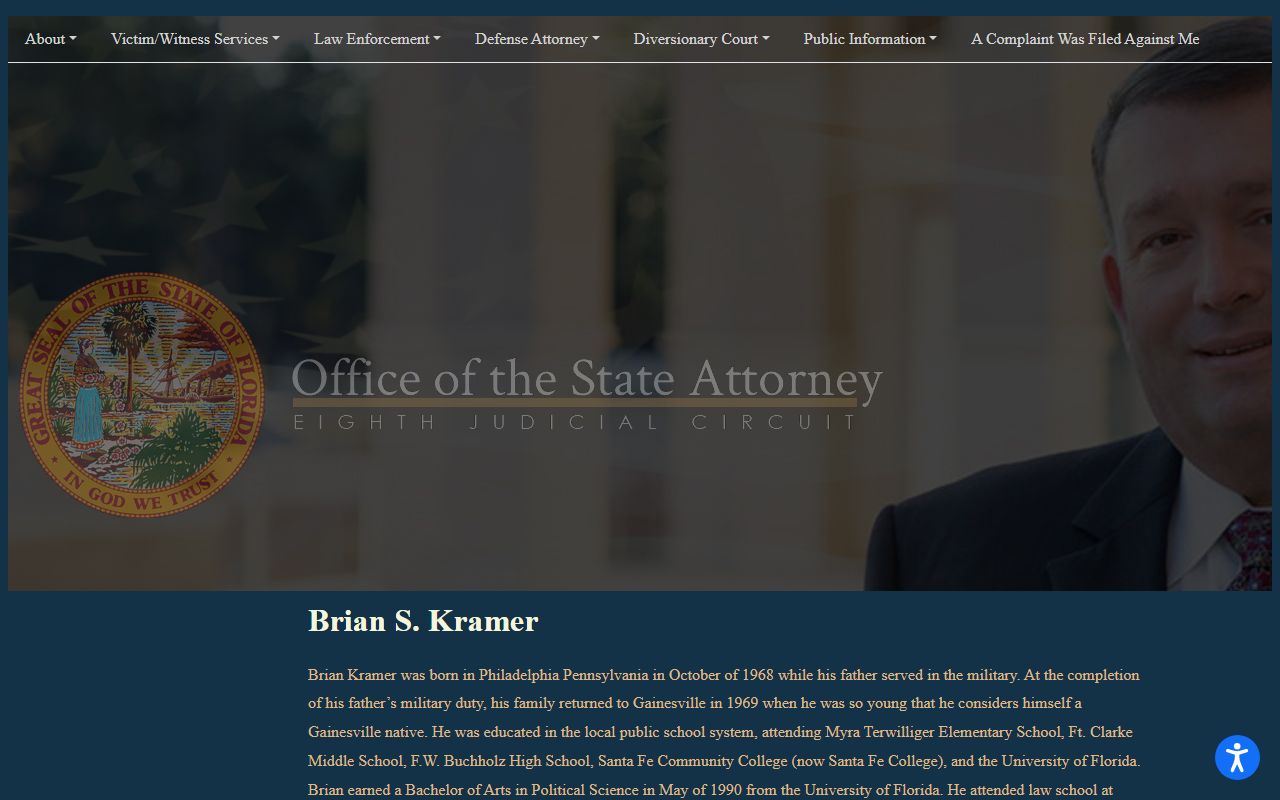
The local Union County State Attorney office is at 103 N. Lake Ave in Lake Butler, open Monday through Thursday from 8:30 a.m. to 5:00 p.m. and Friday until 4:00 p.m. That office reviews law-enforcement submissions and decides what charges, if any, become the court record.
Three Records, Three Offices
After an arrest, the information splits across three separate record systems. Sending a question to the wrong one is the most common delay people hit, so it helps to keep them straight.
- Jail record
- Who was booked, when, by which agency, and whether they remain in local custody. Held by the sheriff's office.
- Court record
- The case number, the charges the prosecutor filed, court dates, bond orders, and the final disposition. Held by the Clerk of Court.
- Prosecutor record
- The State Attorney's charging decisions and case file, subject to public-records rules and exemptions.
Note: The court docket can lag the jail event, because an arrest and booking can happen before the prosecutor files charges and before the clerk opens a case.
Restricted Court Records After an Arrest in Union County
Not every record after an arrest is open. Juvenile cases, sealed or expunged charges, and active investigations can be withheld or limited, and online access is governed by a Florida administrative order rather than the clerk's preference alone. When the Public search does not show a case, the next step is to contact the Clerk's Office for access help. Some files exist but are simply not posted for anonymous viewing.
The portal's notice points to Florida administrative order AOSC 16-107, which sets the rules for online court-record access and explains why an attorney, a registered user, or a party may see more of a case than the public view shows. If a file looks blocked, that is often the access tier at work, not a missing record. The Union County Clerk can confirm whether a credentialed login is needed and how to request access.